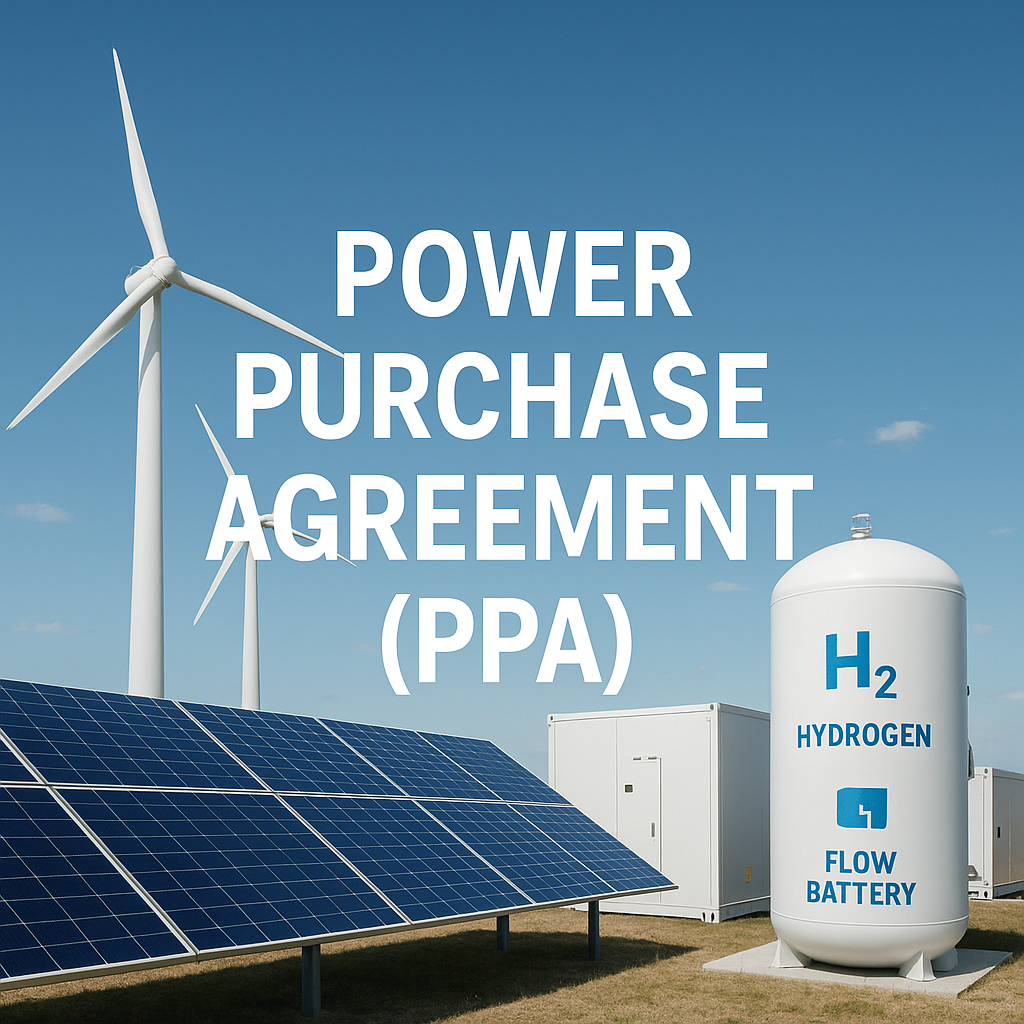
P.P.A
What is a PPA?
A P.P.A. lets you buy clean electricity
generated on your site or remote
(solar + optional vanadium flow battery)
at an agreed price per kWh—no upfront
capex. We design, fund, build, operate,
and maintain the system; you pay only
for the energy it produces.
P.P.A. is the best way to reduce your power bill at an agreed price and could save you money if you’re on a traditional power plan
Why companies choose PPAs
No capital outlay: Preserve cash and debt headroom; treat as OPEX.
Immediate savings: PPA price typically sits below your grid tariff from day one (daytime peak especially).
Price certainty: Hedge against grid price volatility with fixed or escalator pricing.
Performance risk off your books: We carry build, uptime, and maintenance obligations.
ESG impact: Reduce Scope 2 emissions (market-based) and claim LGC-linked renewable use (structure dependent).
Resilience option: With VRFB storage, keep operations running during outages (site configuration dependent).
How our onsite PPA works
Feasibility & data – You share interval data / recent bills; we assess load, roof/land, DNSP.
Commercial offer – kWh price, term (usually 7–15 years), escalation, buyout options.
Design & approvals – Engineering, grid compliance, safety case.
Build & commission – We fund EPC and integrate monitoring/O&M.
Operate & save – You purchase metered onsite energy; grid remains as backup.
What’s included with GreenGrid
Turnkey EPC + O&M: Performance guarantees, remote monitoring, planned maintenance.
Bankable metering: Revenue-grade meters and transparent monthly reporting.
Right-sized storage (VRFB): High-cycle, non-flammable storage for industrial duty.
VIC & NSW delivery: Experience with Powercor, CitiPower, Jemena, AusNet, United Energy and NSW DNSPs.
End-of-term choices: Extend, buy the system, or we remove it (per contract).
Is a PPA right for you?
Annual spend > $300k on electricity or daytime kW peaks.
Consistent weekday load (cold-storage, logistics, manufacturing, data/AI).
Control of roof/land (or landlord consent) and a 7–15 year site horizon.
Willing to share interval data and allow meter/inverter integration.
Typical commercial levers
Tariff comparison: PPA day rate vs. your blended grid energy + network + losses.
Escalation: Fixed or CPI-linked.
Buyout window: Option to purchase at pre-agreed fair market value points.
Environmental claims: Who owns LGCs/RECs—you or the PPA provider.
Example outcomes (illustrative only)
1–2 MWp solar + ~4–6 MWh VRFB: double-digit % bill reduction, improved power quality, and outage cover for critical loads. Actuals depend on tariff, roof, and load profile.
FAQs
Can I exit early?
Most PPAs allow buyout or termination with a make-whole payment.
Who maintains the system?
We do—all O&M, spares, warranties are on us.
What if production is lower?
We carry performance risk except for force-majeure and customer-caused curtailment (see contract).
Who gets the environmental certificates?
Negotiable. If you take LGCs, you can claim renewable use against Scope 2.
Will operations be disrupted?
We stage works and schedule outages to your windows; most cutovers are hours, not days.
Next step (no-obligation)
Book a 20-minute feasibility call. Bring your latest bill or 12-month interval data; we’ll return a PPA price and ROI snapshot for your site in VIC or NSW.